
To end 2013 here’s some nice guitar music by Macedonian musician Vlatko Stefanovski. I will dedicate some pages to his “interpretations” of the famous Macedonian folktune “Jovana, Jovanke” in my forthcoming (e-)book on improvisation, complexity, and singularity which I’m hoping to finish in 2014. Next to that I will be working on a Routledge sounding art companion which I’m editing with Barry Truax from Vancouver and Vincent Meelberg, my colleague at ACPA and co-editor of The Journal of Sonic Studies
Archives for category: Music
To end 2013 here’s some nice guitar music by Macedonian musician Vlatko Stefanovski. I will dedicate some pages to his “interpretations” of the famous Macedonian folktune “Jovana, Jovanke” in my forthcoming (e-)book on improvisation, complexity, and singularity which I’m hoping to finish in 2014. Next to that I will be working on a Routledge sounding art companion which I’m editing with Barry Truax from Vancouver and Vincent Meelberg, my colleague at ACPA and co-editor of The Journal of Sonic Studies

The 4th Annual Conference of the Royal Musical Association Music and Philosophy Study Group (in collaboration with the Music and Philosophy Study Group of the American Musicological Society) will be co-hosted by the Departments of Music and Philosophy at King’s College London, 27-28 June 2014.
The call for papers is now open and available here. The deadline for submissions is Friday, 7 February 2014.
Keynote speakers will include:
- Professor Carolyn Abbate (Harvard University)
- Professor Philip Kitcher (Columbia University)
- Professor Dmitri Tymoczko (Princeton University)
INTERNATIONAL CONFERENCE EMS14, 10-14 June 2014, Berlin
The concert work is still considered to be the epitome of electroacoustic music. During a work’s performance the relationships between composition and audience in time and space are defined as homogeneous – just as in the Aristotelian drama. However, since the 1960s, specific forms of electroacoustic music that challenge the possibility (or conception) of an absolute and exclusive reception have gained substantially in importance. This development resulted in concert forms of extended duration, as well as sound art and music in the media offering the listener opportunities to arrange the perceived sounds in new individual arrangements or to explore the aural space of one piece in various ways.The aesthetical positions and the practical consequences for electroacoustic music that have emerged from these specific environments shall be considered at EMS14 conference.
This EMS conference aims to discuss a number of relevant questions concerning electroacoustic music beyond concert performance among musicologists, composers and sound artists. Musicological studies in this field still lack consistent, rigorous research. Therefore, we explicitly invite papers that focus on aesthetics, history, analysis and practical issues of electroacoustic music of Extended Duration, as Sound Art/Sound Installation, as Media Music, as Conceptual Music, as Participatory Music, in the context of Happenings or extended Concert Forms.
More info on http://www2.ak.tu-berlin.de/Geschichte/Konzerte/2014.06.09-EMS.pdf
The origin of human music has long been the subject of intense discussion between philosophers, cultural scientists and naturalists. Researchers from the Max Planck Institute for Ornithology in Seewiesen, Germany and Cornish College of the Arts in Seattle, US, have now found striking parallels between our music and the song of a small brown bird living in the Amazon region. The Musician Wren favors consonant over dissonant intervals, something that has rarely been observed in other animal species before. This bird’s musicality goes even further: it prefers to sing perfect consonances (octaves, perfect fifths, and perfect fourths) over imperfect consonances leading to some passages which may sound to human listeners as if they are structured around a tonal center.
More info on http://www.mpg.de/7572084/bird-song-human-music
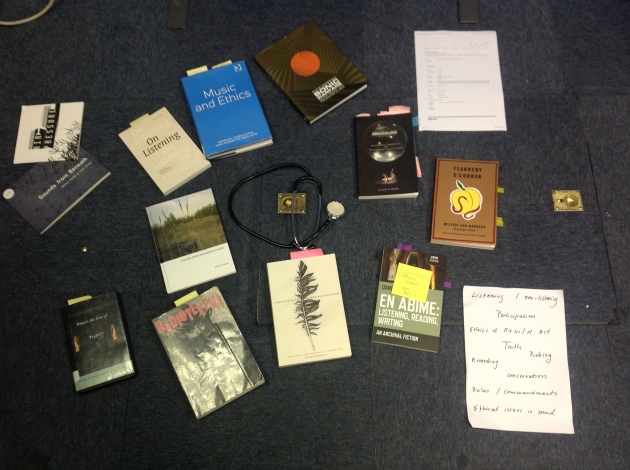
ora is a monthly series of one-hour long debates and voyages into listening and writing by Daniela Cascella and Salomé Voegelin, broadcasted on Resonance 104.4 FM at 8 pm GMT on the 4th Thursday of each month. Every episode will host a debate and enact a voyage with guests, words, and sounds, compositions, recordings, voices and silences, to encounter a number of issues in today’s discourse on listening.
In the third episode of ora (Sept. 26, 2013), Cascella and Voegelin ask questions around listening, sound and ethics: between a radio broadcast from Buchenwald and the ambiguities of a tale of eavesdropping, on the slippery edge between recording and document, between assumptions of truth and practices of listening and non-listening. Special attention was paid to my co-authored book Music and Ethics (Ashgate 2012).
You can listen and get more information here
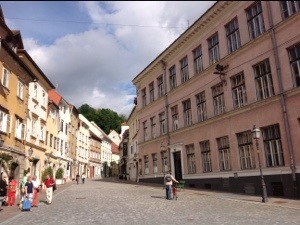
Today I will be the keynote speaker at an international conference on music, the sacred, and the profane, organized by the musicological department of the university of Ljubljana. More info about the conference can be found on http://www.ff.uni-lj.si/oddelki/muzikologija/simpozij2013_spored_eng.html and http://www.ff.uni-lj.si/oddelki/muzikologija/simpozij2013_invitation.html
My presentation will deal with the topic what music as music can contribute to the current thoughts on spirituality, on the spiritual discourse, and, more specifically, on the definitions of spirituality in which a clear distinction is presented between the spiritual, the rational, and the corporeal. Point of departure is the thesis that music does not simply represent certain ideas on spirituality but that it actively contributes toward giving shape to those ideas. Through music, spirituality becomes articulated; music is one medium through which the spiritual is presented, through which the spiritual can manifest itself. In other words, spirituality is not only put into words (including all the problems that this entails), spirituality also (or, perhaps, in the first place) appears outside the discursive domain, for example in, through, or together with musical sounds. What interests me here is to investigate the possibility that, through music, through music as music – that is, through the active perception of music as a sonic event – certain thoughts concerning spirituality can be questioned, brought up for discussion, and submitted to reconsiderations. More specifically, I would like to address the question whether the opposition between the spiritual and the corporeal can be deconstructed through music as music, thereby opening a space to present another spirituality, a material spirituality.
How can one represent a city on film using an inter-disciplinary approach based on sounds? Andrew Standen-Raz’s movie Vinyl deals with the topic how to “view” a city through its sounds, mediated sounds created by musicians as well as mediated and free sounds created by speech, transportation, random sounds, and other forms of communication. Vinyl explicitly explores the creative methods and cultural influences of musicians and how their own relationship to the city of Vienna affected their music and their sense of self. Many of them are part of the klingt.org community of sound artists, experimenting with anything and everything to communicate through sounds.

International course for composition and sound art
For the fourteenth time Musica organizes a composition course for young people and adults with a passion for composing and creating. During five days and in an inspiring environment, they challenge the boundaries of their own musical imagination. At the end of this week, the participants show their creations.
From this year on, the perspective is widened with a brand new course for sound art, in collaboration with ChampdAction. With the unique collection of artworks in Klankenbos as a source of inspiration, a selected group of young artists will work with sound, music and the environment.
SoundMine is led by international top teachers Wim Henderickx (www.wimhenderickx.com) and Volker Staub (www.volkerstaub.de).
Practical information: see http://www.musica.be/en/soundmine
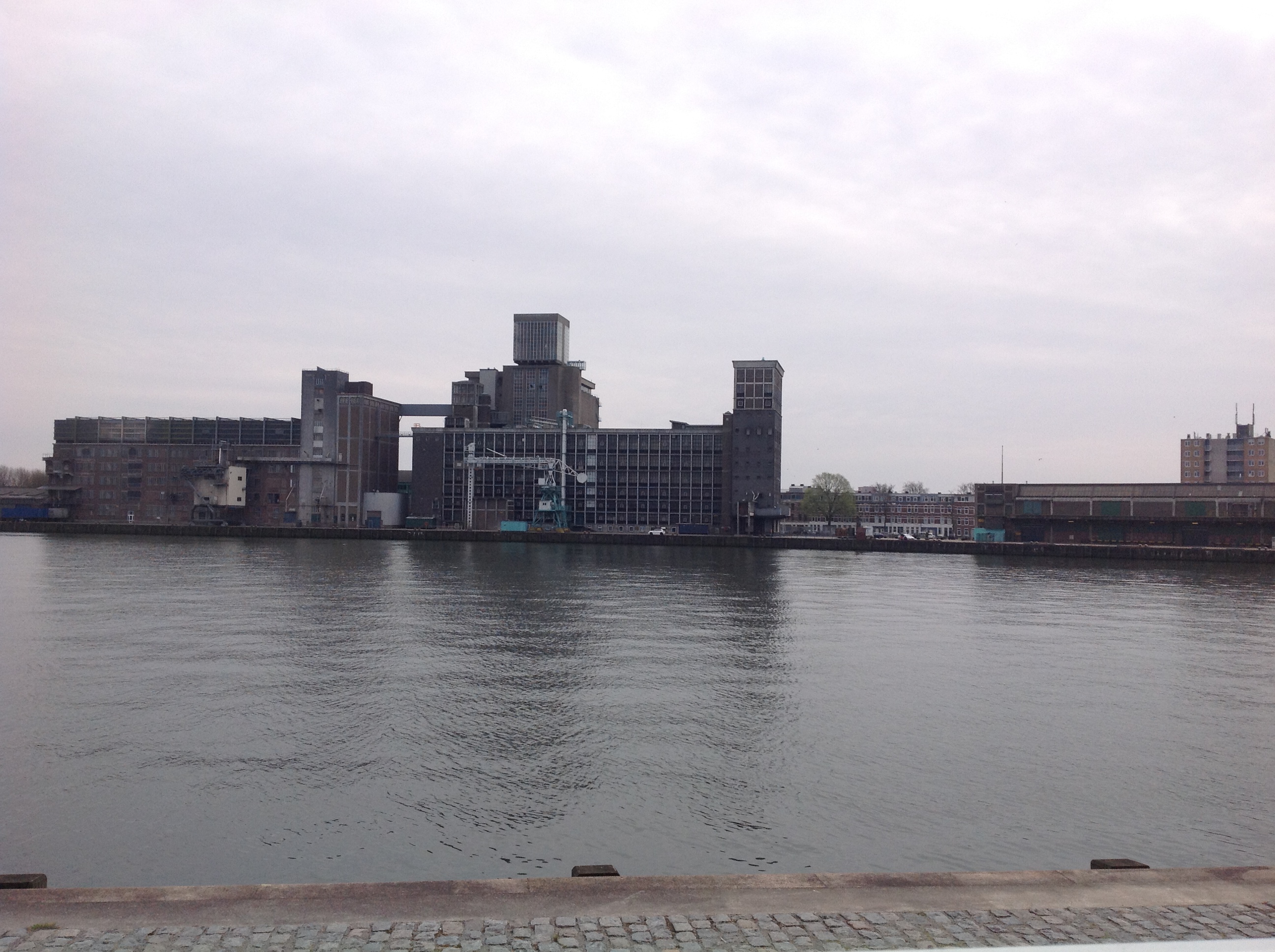
April 21, 2013, was the last day of a great festival on one of the most beautiful spots of Rotterdam, the Wilhelminapier.
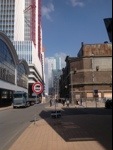
The festival – biannually organized and lasting three days – is called Red Ear. Festival with Daring Music .
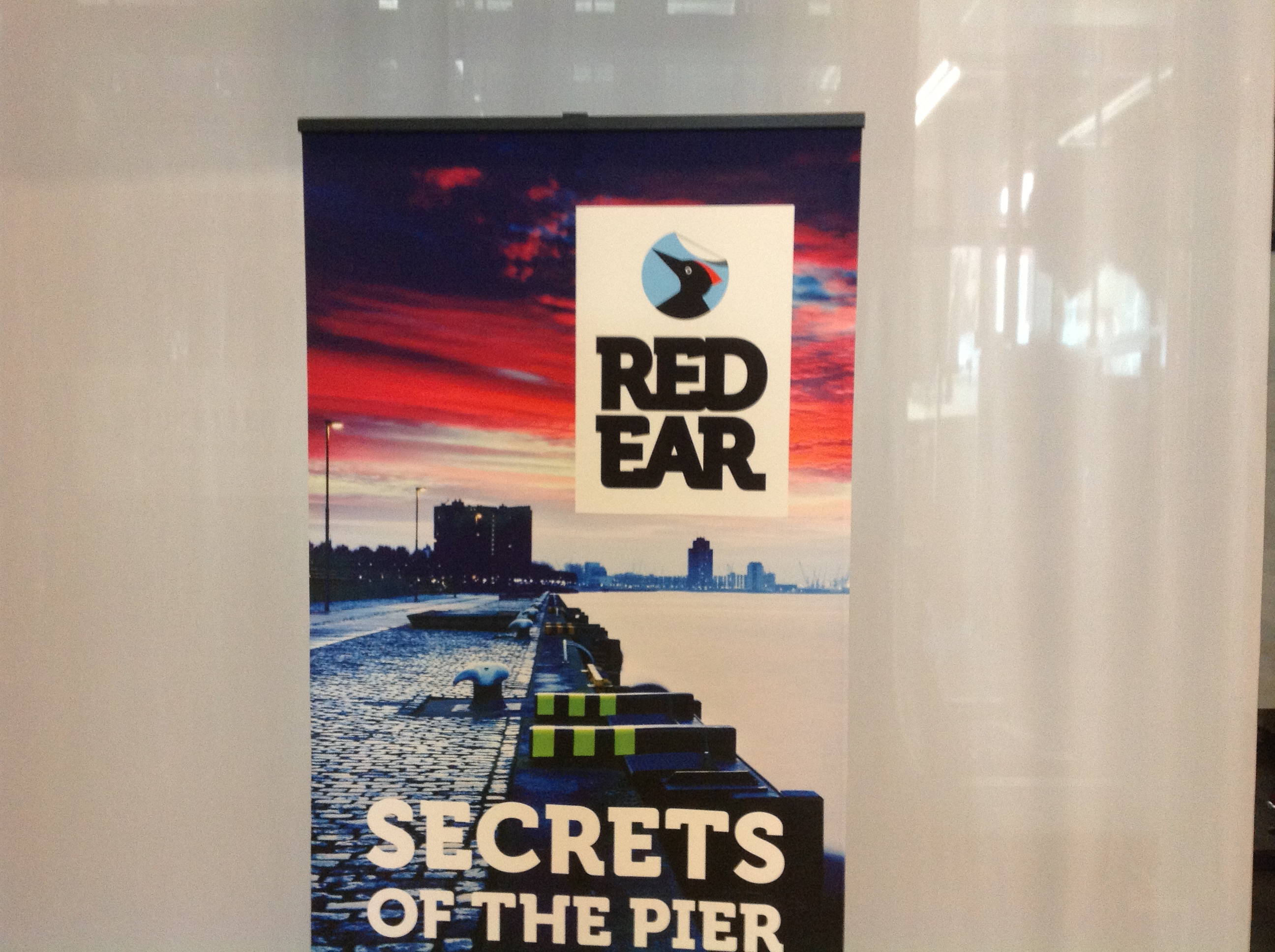
It has a beautiful and challenging mix of jazz, modern classical music, sound art, improvised music, multi media installations, avant-garde music, electronic music, etc.
Here is a short impression of the last day of the festival, far from complete as there were over 16 performances scheduled, next to several sound installations and multi-media events.
12.00-13.00: Cloud of Identity Michel Banabila (sounds) and Geert Mul (images)
One of the most perfect combinations of visual and audio materials I have ever visited. The three big videoscreens and the impressive soundscapes gave comfortable as well as uncanny experiences of immersion. Cloud of Identity is based on the use of vowels and consonants in various linguistic systems.
13:00-14:00 Piano Concert in the Dark Untitled #275 Reinier van Houdt (piano) and Francisco Lopez (composition)
Listen to the repetitive, percussive, hammering sounds of the lowest parts of the piano. Prepared sounds, like in a Cage composition. Later on the mood changes and Van Houdt starts playing slow and soft chord progressions which reminded me of Morton Feldman.
In the second part of the piece, electronics take over and the piano remains silent. Are we listening to the same hammering sounds of the piano with which Lopez’composition opened? It seems like he has recorded and processed them, a bit like Alvin Lucier’s Nothing is Real, although without a teapot. As usual with Lopez’ pieces, it has to be experienced in the dark.
14:30-15:30 Bodurov Trio & Theodosii Spassov
Combining jazz with Balkan sounds and rhythms is not something new: Dusko Gojkovic, Bojan Zulfikarpasic, Ivo Papasov, and Slobodan Trkulja are but a few examples of succesfull musicians who have preceded the Bulgarian pianist Dimitar Bodurov, bass player Mihail Ivanov and drummer Jens Düppe. Nevertheless, the technical capacities of the musicians, the many tempo and mood changes in each tune, and the use of sound recordings, add something extra to this music in which East and West meet. Here the trio is complemented with kaval player Theodosii Spassov.
15:30-16:30 Stian Westerhus Solo
Electric guitar, computer, amplifiers, and an impressive amount of effect equipment – that’s the instrument with which Westerhus is interacting. The results consist of layers of sound, sometimes dreamy and tonal, at other moments rough, raw, and noisy.
16:30-18:00 The David Kweksilber Big Band
This is a piece by Ned McGowan, especially composed for this Big Band, for this Festival, and for the biggest building on the Wilhelminapier, Rem Koolhaas’ The Rotterdam.
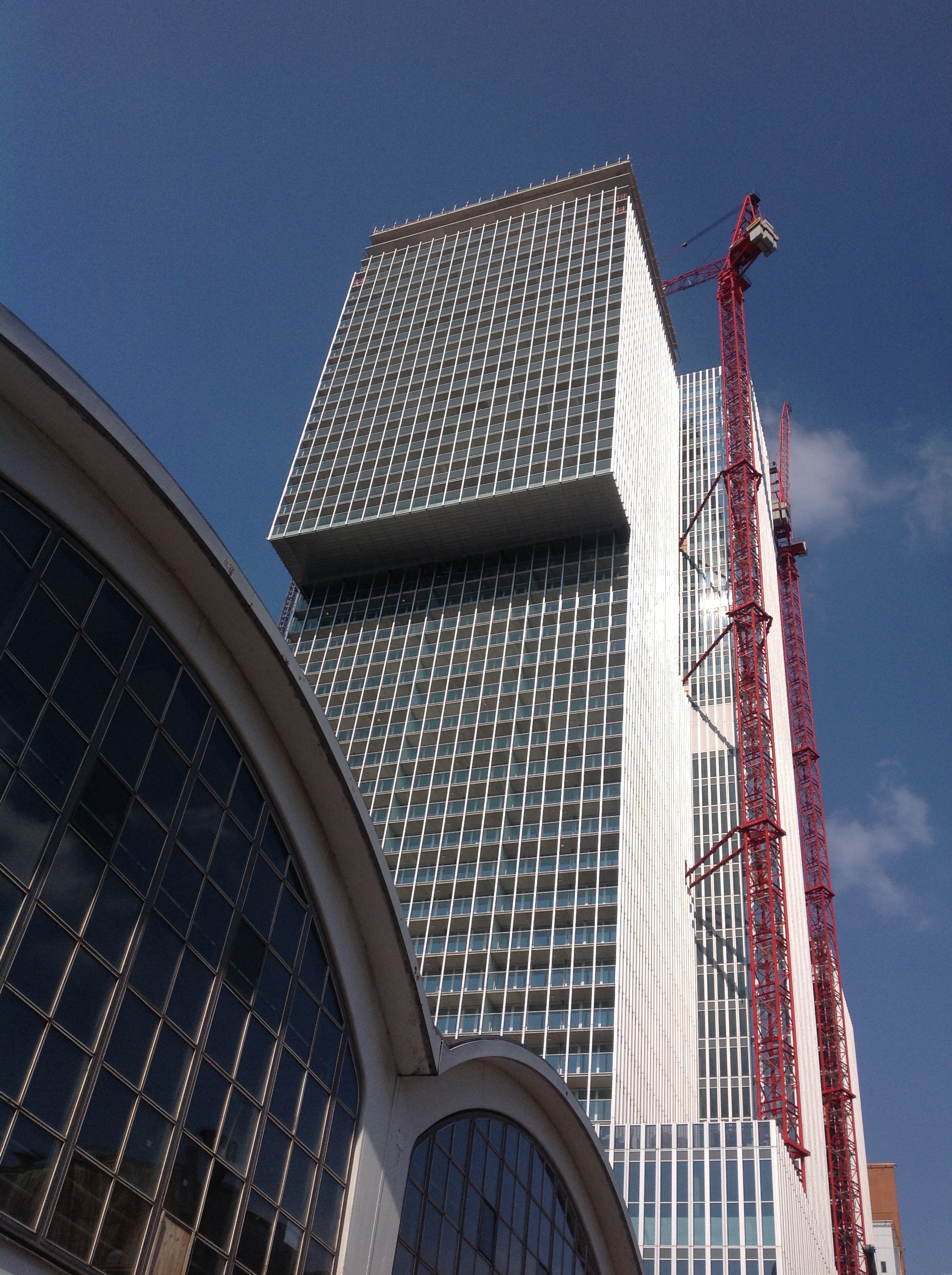
The piece is loosely based on Ligeti’s Poeme Symphonique for 100 metronomes. Here, each big band member has its own meter. Perhaps this corresponds with the (a)synchronisity of the building itself.
 Thinking Sounds