What is the relationship between society and music? Everyone will agree that a society’s economic, social, technological, and political situation, as well as its norms and values affect which music can be listened to, and how, where and when music is produced, distributed, and experienced. However, the fact that music depends on technological, economic, and social developments does not mean that it is simply and solely a causal effect of these developments. Music plays an active and dynamic role in the formation of a society. Each society is constituted by and through many different practices, and music is one of them. Through music we get certain experiences – Bach’s Matthew Passion might evoke religious or spiritual feelings. Music gives us access to specific emotions, from sad to pleasant ones. It influences our behavior – think of how deejays can make us dance. It can express and distribute certain ideas – ideas about politics, gender, sexuality, religion, etc. Music can create communities but also destroy them; it demarcates spaces and creates specific atmospheres. The list can easily be expanded. Taking the idea that music co-creates our society as a point of departure, I will investigate in my presentation what this means for professional music education. What roles can conservatory alumni play in our contemporary, everyday lives? Is it necessary to rethink and perhaps expand those roles? And how can artistic research be helpful here? What new perspectives can be developed so that music will be regarded (again) as crucial to our well-being, as indispensable for a reorientation on our civilization? Yes, this is going to be a lecture that can make a difference!
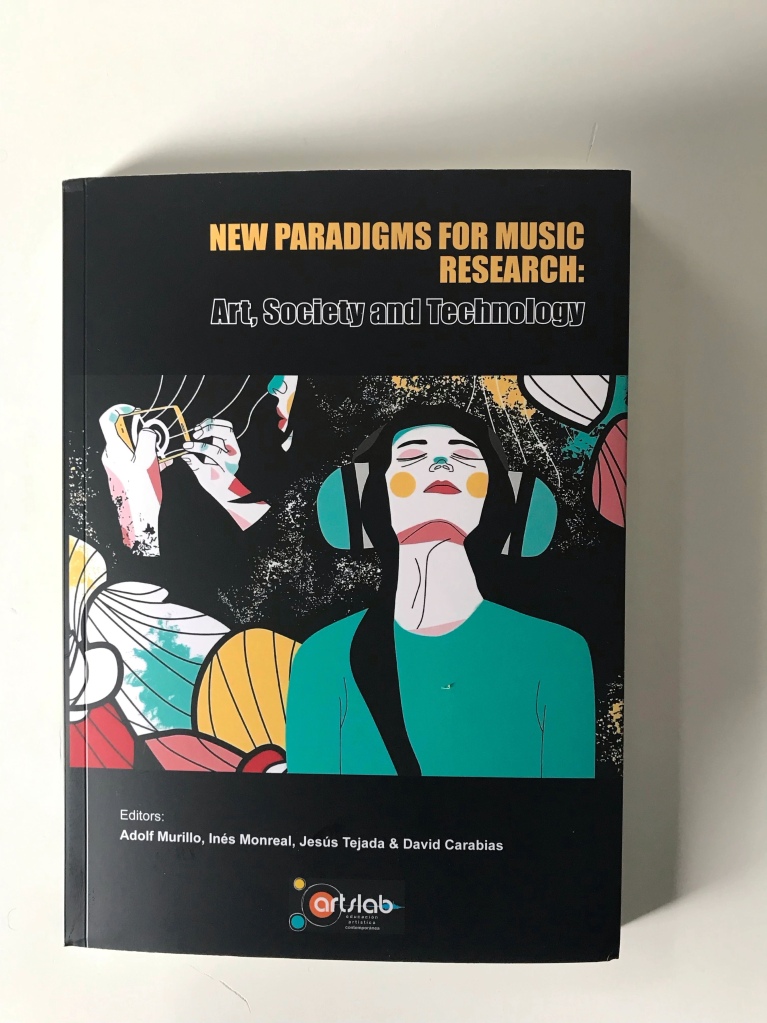
Today, I found this book on my doormat: New Paradigms for Music Research: Art, Society and Technology, edited by Adolf Murillo, Ines Monreal, Jesus Tejada and David Carabias and issued by the University of Valencia (Spain). Contributors are participants to the first International Conference on the Intersection of Art, Society and Technology in Musical Innovation in 2021, organized by the same university.
My contribution consists of a text on soundwalking, mostly concentrating on my development of a soundwalk in Leiden, the Netherlands in 2021. My claim is that this art form takes in fact place between art and non-art and as such has both artistic and societal significance.
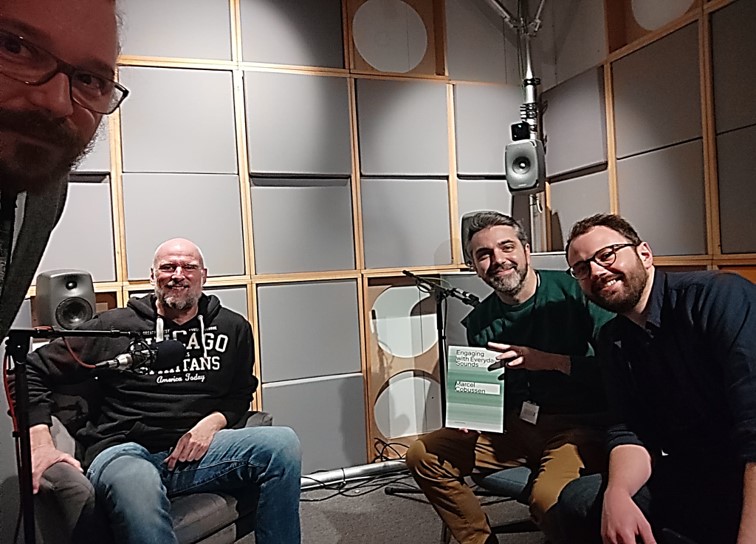
Last week I’ve recorded a podcast together with Francesco Aletta, Tin Oberman and Andrew Mitchell in London based on my latest book Engaging With Everyday Sounds. Will be broadcast soon.
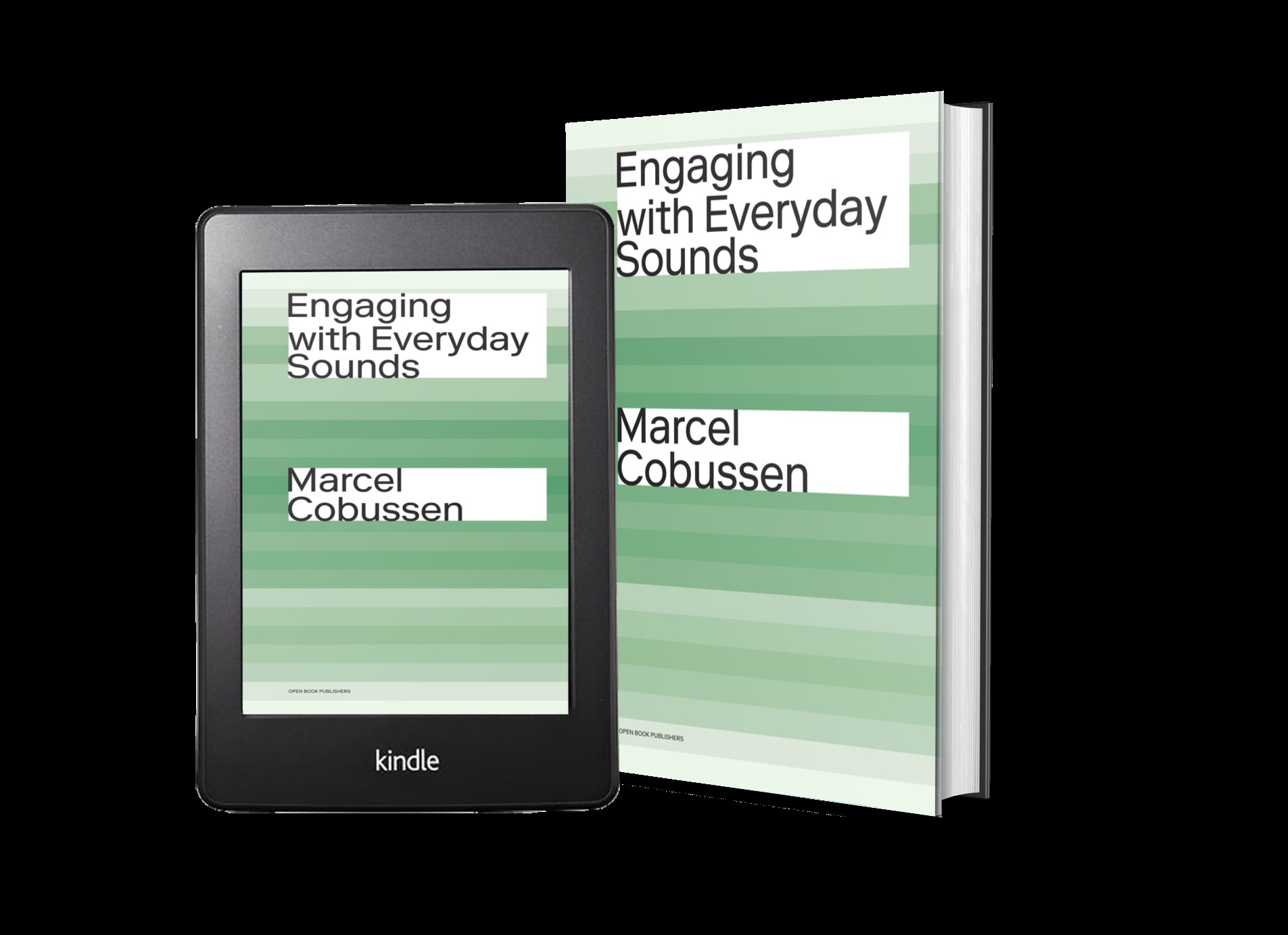
I’m happy to announce that my new (e-)book “Engaging with Everyday Sounds” is now freely available. Please go to https://www.openbookpublishers.com/books/10.11647/obp.0288 to download the book in various formats.
‘Engaging With Everyday Sounds’ explores the role of sounds in everyday life, including their impact on human actions, emotions, and imagination. I intertwine sonic studies with philosophy, sound art, sociology and more to create an innovative guide to sonic materialism, calling for a re-sensitization to our acoustic environment and arguing that everyday sounds have (micro)political, social, and ethical impact to which we should attend.
Exploring the intellectual history of sound studies as well as local, global, and temporal sonic geographies, I weave audio files, images, and journal excerpts into this work to create a multimodal monograph that explores the relationships of humans, nonhumans, and their environments through sound. The book contains an interdisciplinary collection of short essays, which might be valuable reading for both academics and the general reader interested in sound studies, sound art, philosophy, or the sociology of everyday life—and for anyone keen to think about the sonic in new and engaging ways.
On December 6, 2021 I hosted a special event in Studio Loos in The Hague (the Netherlands) on Sonic Materialism. Featuring the American trombone player, theoretician, and instrument builder Kevin Fairbairn, the Welsh composer and improviser Richard Barrett, and the Argentinian sound artist and composer Gabriel Paiuk, the event was comprised of 3 lecture-performances (and a brief introduction by me), exploring how Sonic Materialism can sound, how sound as sound can contribute to a more theoretical discourse on (New) Materialism.
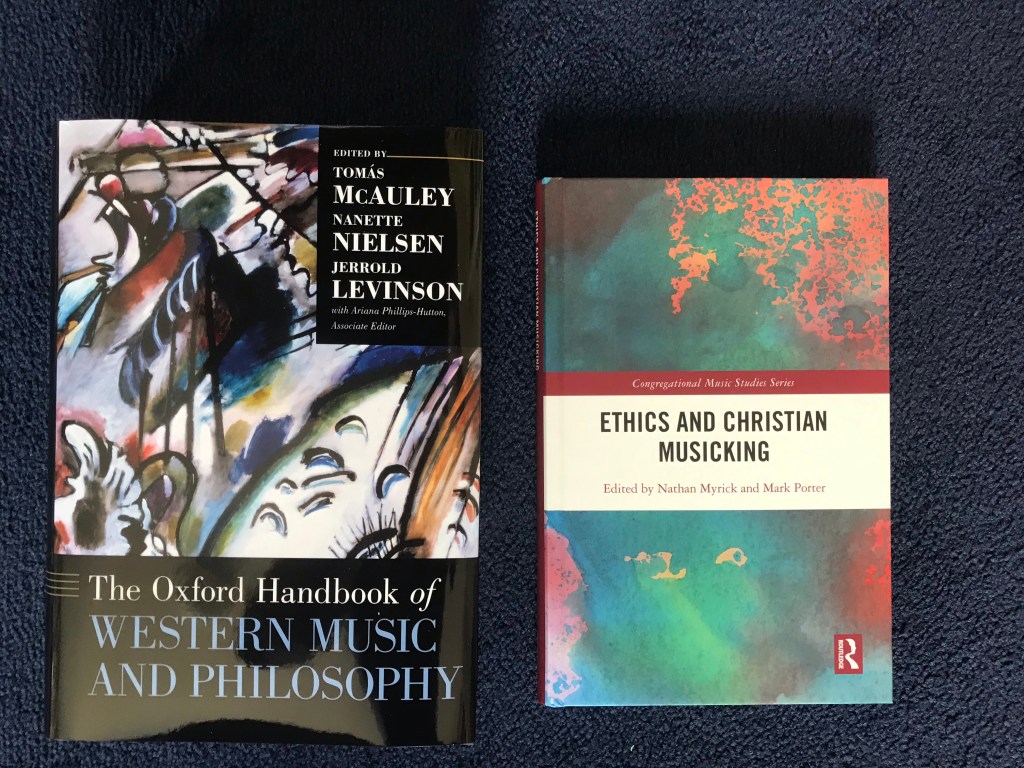
Today two new books arrived, both containing an essay of mine. The Oxford Handbook of Western Music and Philosophy includes my reflections on (everyday) listening; my contribution to Ethics and Christian Musicking is called “The Silence of the Monks” and takes as its point of departure the friary of the Carthusian order in a French monastery. The monks are not allowed to speak but of course always surrounded by (and themselves producing) sound.
Recently published: Musik, die Wissen schafft. Perspektiven kunstlerischer Musikforschung, edited by Arnold Jacobshagen. The book contains many interesting essays, from Darla Crispin, John Rink, Deniz Peters, and Barthold Kuijken, among others. Also a text by me, entitled “Kunstlerische Forschung und Klangkunst im offentlichen Stadtraum” about sound artworks in public urban spaces by Max Neuhaus, Peter Cusack, Edwin van der Heide, and Asa Stjerna in relation to micropolitics and sonic materialism.
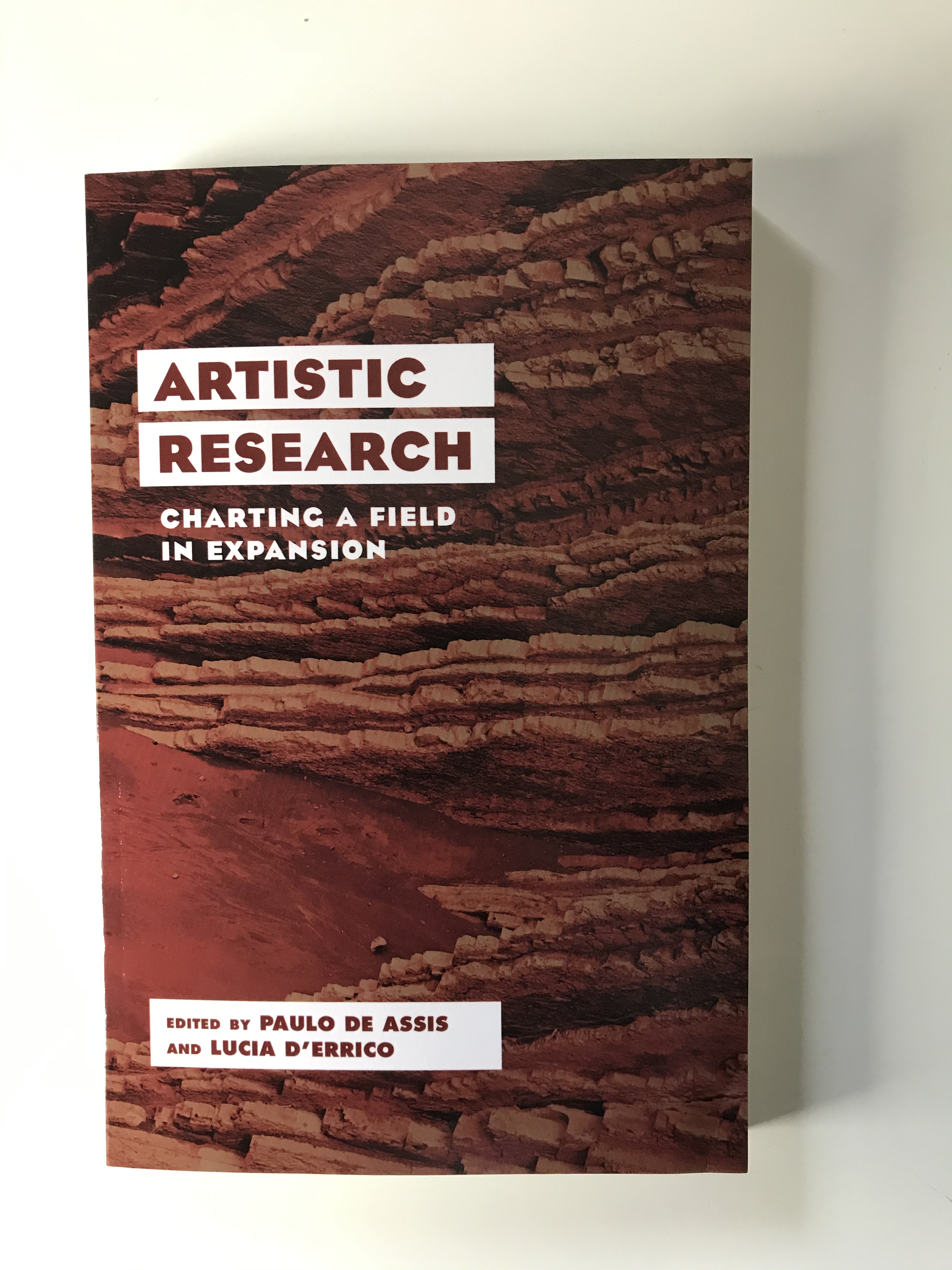
This book fell this morning on my door mat. It contains great essays by Michael Schwab, Jonathan Impett, Juan Parra, Mieko Kanno and many others … and one by me too: “Artistic Research and Sound Art in Public Urban Spaces.”
From the article: “It is the aim of this chapter to expand and examine in more detail how artistic research and sound art relate to one another. To do so, I will concentrate on several existing sound art works, all situated in public urban spaces. The main reason for this demarcation is that working on and with public urban spaces often requires more “research” from the sound artist than producing a so-called autonomous, non-site-specific art work. I will try to answer questions such as: How do sound artists contribute towards developments in the arts as well as knowledge production? Which spaces of research and which methodological tools do they use? Which new concepts have they developed? It is my hope that this chapter will show that artistic research and sound studies—both still marginal (and marginalised) in current academic fields—contribute in significant and unique ways towards rethinking our being-in-and-with-the-world.”
In what follows I pay attention to Max Neuhaus, Peter Cusack, Edwin van der Heide, and Asa Stjerna, and connect their work to micropolitics and sonic materialism.




 Thinking Sounds