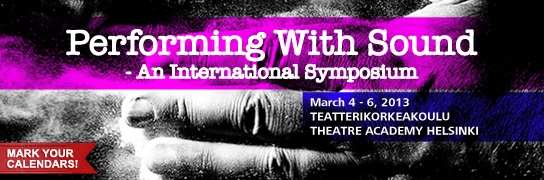
On Monday March 3 I give a presentation in Helsinki on sonic epistemology: what would a sonic paradigm sound like? In other words, how can we continue the works of Jean-Luc Nancy on the resonating subject, Christoph Cox on sonic materialism and Salome Voegelin on the contingencies of listening?

Image

Afbeelding

Conclusion of a research done by a Dutch Professor of pop music: adolescents listening to ‘non-conventional’ music – metal, gothic, hardcore house, hip hop – have a much greater chance of becoming involved in vandalism, shoplifting, or brawls than kids listening to top 40, classical music, jazz, or singer-songwriters.

What do this Dutch Professor, the Taliban, Richard Taruskin, and Frank Zappa (although with a wink) have in common? Somehow they all seem to agree with what Plato said some 25 centuries ago: (certain) music should be forbidden in order to create and maintain a decent and stable society. Yeah, music is dangerous …

Want to read the whole article? Click here (in Dutch)

Afbeelding

3rd Annual Conference of the Royal Musical Association Music and Philosophy Study Group. Department of Music and Department of Philosophy, King’s College London
Friday and Saturday, 19-20 July 2013.

Conference theme 2013: ‘Embodiment and the Physical’

Philosophers and musicologists have provided various ways of thinking through music in relation to its concrete particularity as sound, and its bodily nature in performance and hearing. In particular, they have paid attention to the phenomenology of listening; to the physical nature of sound and its relation to our perceptual experience; and to the bodily aspects of musical performance and their inscription in the gestures of musical scores. What exactly is the relation between sound and music? How is the body involved in the experience of sound, and of music? When answering such questions, what can philosophers learn from musicologists, and vice versa? Music is often conceived very abstractly, and music as ‘embodied thought’ both poses challenges and opens up new possibilities. This year’s (optional) theme seeks to encourage further philosophical and musicological debate about music within the area of ‘embodiment and the physical’.

More information is available on the conference website.

According to the German studio Finally one cannot understand music. One can be seduced by music, or simply enjoy it. But to understand it – that’s impossible. See their animation below.

The main idea reminds me of an interview Pierre Boulez once had on a French television station with a writer whose name I’ve forgotten. First music is a mystery, the writer told Boulez. Then, after studying it, everything becomes clear. But, finally, with the performance, it becomes a mystery again.

The central question, however, remains: can some knowledge about music enhance the enjoyment or is knowledge sometimes obstructing certain encounters with music? Or do both statements contain some kind of truth?

The Journal of Sonic Studies #3 is online since yesterday (December 4, 2012).
A special on sound and television. Guest editors: Anthony Enns and Carolyn Birdsall. Six multimedia essays representing the current state of affairs in reflections as to how television and sound relate to one another. See www.sonicstudies.org!

sonicstudies-banner

On December 7, 2012 I’m organizing a small, 1-day conference on auditory culture in The Netherlands. 20-25 people dealing with sound will gather in a venue in Leiden to discuss sound: philosophers, sound artists, biologists, architects, audiologists, sound designers, psychologists, people from governmental organizations dealing with noise abatement, etc. Aim is to exchange thoughts, to transgress discourses, and to develop a common research strategy. 

British scientists have ‘discovered’ the most annoying sound: not the famous nail scraping on a blackboard, but scratching a glass with a knife. The more annoying, the more activity in the amygdala, the part of the brain controlling our emotions. A second category of annoying sounds consists of sounds that evoke bad associations.

To read more about this research, click here (in Dutch)

Yeah! It’s there, my (co-author Nanette Nielsen from Nottingham U) new book on music and ethics. With the final answers on how music ‘as music’ might contribute to the (philosophical) discourses on ethics and to concrete moral behavior. Keywords: listening, interaction, and engagement. From Alban Berg to Jacques Derrida, from Bob Dylan to Alain Badiou, from Sachiko M to Gilles Deleuze, from the chants of football fans to Zygmunt Bauman, and from Richard Taruskin to sonic weapons …

More info: click here

On September 12 elections were held in The Netherlands. What kind of music did the political parties choose while they were waiting for the final results and just before the party leaders went on stage to give their speech? The choice for a particular tune says a lot about the party’s mood, whether they’ve lost or won. Sometimes the choice is rather awkward: the liberal (right-winged) party playing Coldplay’s ‘Viva la Vida’ for example. Did they really understand the lyrics? Moreover, the clip of ‘Viva la Vida’ starts with a bursting red rose – the symbol of their biggest adversary, the social democrats.
Read more here (in Dutch)