
Mid November 2023 I had the pleasure of being invited for a keynote presentation at the kick-off of the Applied and Experimental Sound Research Lab (AESR) in Vienna (Austria). In this presentation I combine insights from my book Engaging With Everyday Sounds with my advisory work for (non)governmental organizations on the sound design of public spaces, and some ideas about the extended role artistic research might play in contemporary society.
Archives for category: Conference

Reworked text of a presentation I gave in Torino during Forum Acusticum 2023: “The Role of Sound Art in Soundscape Design.”
On 27 and 28 February 2023, the first Sound Arguments session will take place in Studio Loos in The Hague. Sound Arguments is an initiative of Jonathan Impett, Magno Caliman (both working at the Orpheus Institute in Ghent) and myself.
Sound Arguments will bring together sound artists, sound studies scholars, organizers, PhD students working on/in/through sound, etc. Next to lectures and presenting own work, there’s room for workshops.
Our first guest will be the marvelous Argentinian composer-musician Cecilia Arditto; she will give a lecture on notation, perform her cycle Musique concrete and organize a workshop on composing with everyday (sounding) objects. See also here.
For more information on Sound Arguments, please click here

Together with Vincent Meelberg I organized a special session entitled Soundscapes from a Humanities/Arts Perspective during the Internoise 2019 Conference in Madrid. Find here a short text I composed for the conference proceedings. In the text I rethink the role sound art can play in relation to soundscapes, a role that exceeds the merely audible.

This text is a slightly reworked version of a keynote speech I gave in Aveiro (Portugal) during the PERFORMA 2015 Conference on Musical Performance, organized by the University of Aveiro, the Institute of Ethnomusicology (INET-MD), and the Brazilian Association of Musical Performance (ABRAPEM).
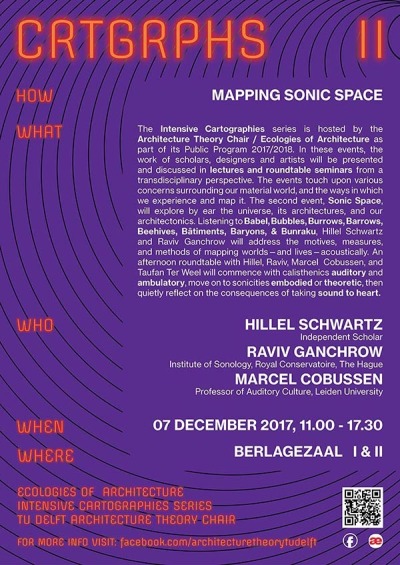
Conference dates: 29-30 November 2016
Location: Leiden University, the Netherlands
Introduction to the Conference Topic
Sound is among the most significant, yet least-discussed, aspects of public spaces in urban environments (Hosokawa 1984; Kang and Schulte-Fortkamp 2016). Architects, engineers, and urban planners invariably stress the visual and tactile aspects while (re)designing urban environments but often pay less attention to the aural consequences of their interventions; sound tends to be considered mainly as an inevitable byproduct of industrial areas, traffic, commercial centers, and/or human activities. If sound attracts the attention of policy makers and users of public urban spaces, it is often in a rather negative context: as noise pollution which should be avoided by somehow reducing the amount of decibels (Devilee, Maris, van der Kamp 2010; Elmqvist 2013; Kamin 2015).
In contrast, this conference aims to increase the attention to the role of sound, sound design, and sounding art in urban spaces – with sound considered both as an epistemological tool and as an aesthetic instrument.
Sounds in urban spaces – including the “omnipresence” of music – (co-)regulate our behavior, attract specific groups that give a space a specific identity, call for certain actions, make us nauseated, etc.; sounds thus have social, political, ethical, and economic power. Reflections on everyday urban soundscapes – their features as well as the way they are used and experienced – could lead to a new theory of sonic ecology.
Furthermore, sounding art has the potential to contribute directly to an improvement of city soundscapes, while a more fundamental and scholarly attention to sounds in public urban spaces can lead to a concrete contribution to already existing discourses in urban studies, history, anthropology, and philosophy.
In this conference three questions will play a central role:
- How do sounds in general and sounding art in particular contribute to the general atmosphere of a public urban space?
- How do users of that space – dwellers, tourists, people working in that neighborhood, passersby – experience its sonic qualities and how does that influence their behavior as well as the function of that space?
- How can we, on a theoretical level, develop a new sonic ecology?
Keynote speakers: Salomé Voegelin, Gascia Ouzounian, Holger Schulze, and Jean-Paul Thibaud.
Conference Coordinator: Prof. dr. M.A. (Marcel) Cobussen
(M.A.Cobussen@umail.leidenuniv.nl)
Abstracts: Abstracts of no more than 250 words should be sent to Gabriel Paiuk acpa@hum.leidenuniv.nl before October 1, 2016. Submitters will be informed before October 15.
The conference is sponsored by KNAW, LUF, JSS, and ACPA (Leiden University)




Call for Papers
The capacity to be in time together lies at the heart of all music-making and is one of the most profound of human capabilities; being in time together is implicated in social bonding, altered states, and foundational pleasures associated with music. The ways in which we play in time together, also mark out difference-between genres and between instruments (and instrumentalists), between studio and live performance, between the virtuoso and the beginner.
Two assertions about the temporal in music are the starting point for our call for papers: David Epstein’s comment in his seminal book, Shaping Time, that time is ‘the critical element in performance’, and Lefebvre’s lament that rhythm has been music’s neglected component. These comments underscore the aim of this conference, which is to bring time and timing to the fore in our thinking about musical experience, and in particular, its production.
The conference committee encourages submissions from scholars representing diverse disciplines whose interests lie in time, timing and timekeeping, and their construction by musicians. We welcome papers that address the subject from the following broad perspectives: the psychological/cognitive foundations of this human achievement, time and timing as part of specific cultural praxis, critical approaches to time and technology, the aesthetics of timing, and musical time’s relationship to social being.
The following list of questions indicates some broad concerns of the conference but is suggestive rather than prescriptive.
– How is the time of music implicated in social being and sociability? In what ways does the social penetrate the temporality of music?
– Can we speak of cultures of time in music? How does the relatively tacit feel for time amongst musicians connect with the discursive?
– What is the relationship between the relatively automatic capacity to be in time together and timekeeping as intentional and expressive?
– In what ways have technologies changed our relationship to time in music? Is temporality changed through developments in recording and digital technologies?
– What are the politics of musical time?
– What methods are available to us to address questions of temporality, music, the social and the psychological?
– How do we teach and learn about time in music?
Proposals of 250-300 words are invited for spoken papers of 20 minutes. These should be sent as a Word attachment to makingtime@music.ox.ac.uk and must include the following: Title, author(s), affiliation(s), email address for contact. The deadline for proposals is Friday 15 April 2016 at midday. Decisions on proposals will be communicated by Monday 9 May 2016.
It is hoped that some papers from the conference will contribute to a volume, Making Time in Music, edited by Mark Doffman.
The conference committee is: Dr Mark Doffman, Dr Jonna Vuoskoski, and Dr Toby Young (all University of Oxford), and Dr Emily Payne (University of Leeds).
|

 DARE 2015
|
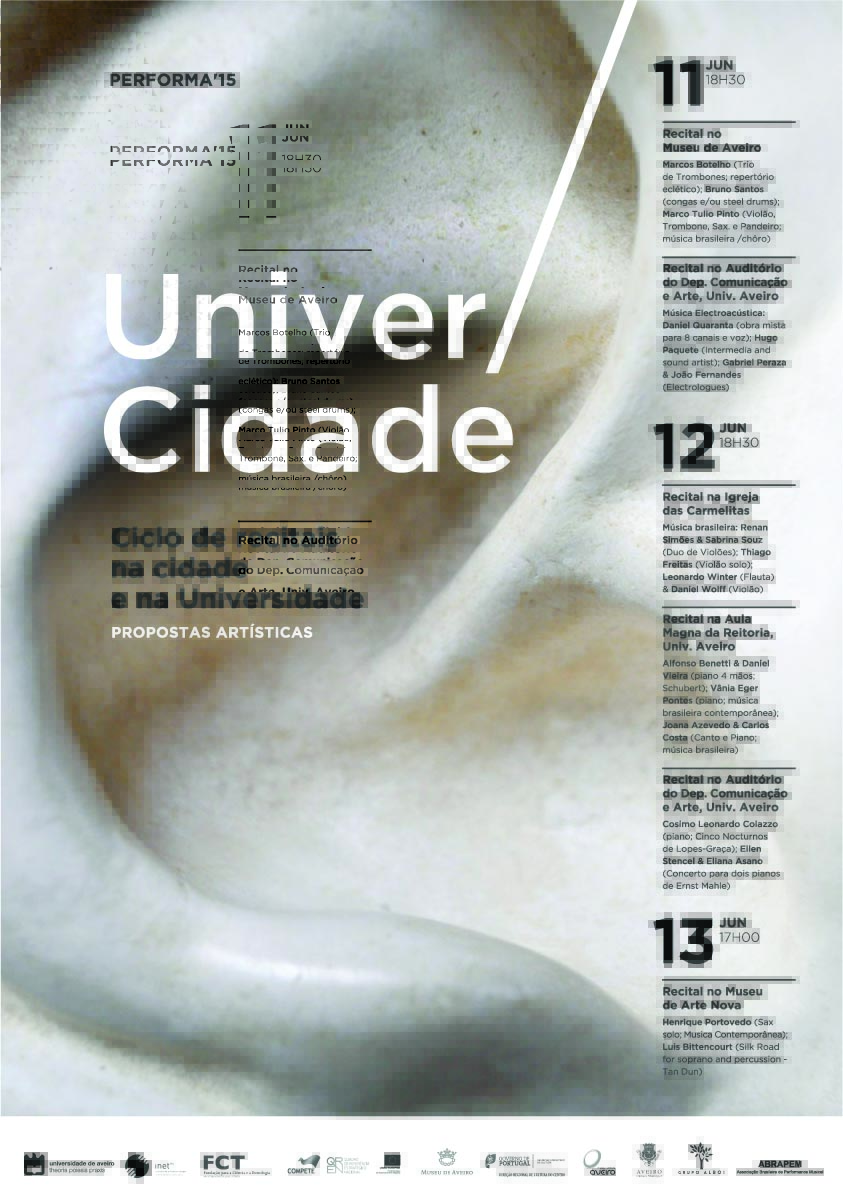
From June 11 till 13 Performa ’15 will take place at the University of Aveiro in Portugal. On June 11 I will open the conference with a keynote lecture entitled “Musical Performances are (not) Artistic Research”. Of course I will pay attention to my favorite topic, the relation between artistic research and knowledge; however, the major part of my presentation will consist of particular musical performances and their relation (or not) to artistic research.
 Thinking Sounds