Archives for category: Music

whisper opera

The setting:  Four stages separated by semi-translucent lace curtains. Each stage contains one instrument besides a hanging big drum and a cymbal. The audience (max. 48) is divided in 8 x 6 people and seated in between the four stages so that each group of people can only see one stage.

The beginning: four musicians on the four different stages start playing the cymbals by, for example, turning them around and around; the sound is barely audible. After a while, they start whispering short textual fragments in a polyphonic style.

The middle: a beautiful musical conversation between flute and clarinet. It is almost impossible to distinguish which sound is coming from which instrument. They interact as a kind of echoing.

The end: the loudest part of the piece, though still really soft – an affecting aria (the first and only time the female vocalist really sings), accompanied by cello, clarinet, flute, and keyboard. The ending is quite abrupt.

David Lang’s Whispering Opera. Fantastic!

WP-Header-21
We’re delighted to announce that our 2015 Annual Conference will take place at King’s College London on 17-18 July 2015. The event will be co-hosted by the Departments of Music and Philosophy at King’s College London and the Institute of Musical Research, University of London. As part of our first ever tri-continental partnership, the event is being held in collaboration with the Music and Philosophy Study Group of the American Musicological Society and De Musica – Laboratório de Estética e Filosofia da Música (Brasil).
The optional theme for the event is “Music and the Senses.” The call for papers is now open!
http://www.musicandphilosophy.ac.uk/conference-2015/call-for-papers/
The deadline for proposals is 7 March 2015. Outcomes will be communicated to all authors by 21 March 2015 in order to allow plentiful time to make travel arrangements for those coming from further afield who may only be able to attend the event if a paper is accepted.
Keynote speakers will include:
  • Professor Christopher Peacocke (Columbia University)
  • Professor Kay Kaufman Shelemay (Harvard University)
There will also be a plenary panel discussion on the theme of “Absolute Music,” featuring panelists:
  • Professor Mark Evan Bonds (University of North Carolina at Chapel Hill)
  • Professor Simon Frith (University of Edinburgh)
  • Professor Hannah Ginsborg (University of California at Berkeley)
Further information on these speakers is available here:
http://www.musicandphilosophy.ac.uk/conference-2015/keynote-plenary-speakers/ 
For more information on all aspects of the conference, please visit the conference website:
http://www.musicandphilosophy.ac.uk/conference-2015/ 

Sussex

The School of Media, Film and Music (MFM) at the University of Sussex is pleased to invite applications to study for a PhD.

We offer expert supervision in the following areas:

As a member of CHASE, the AHRC Doctoral Training Partnership, MFM is able to offer a number of studentships to well-qualified candidates. CHASE is the Consortium for the Humanities and the Arts in Southeast England, a partnership of 7 institutions (Sussex, UEA, Kent, Goldsmiths, Essex, the Courtauld Institute and the Open University). £17m has been awarded to provide doctoral training and to promote excellence in research, including the funding of 75 scholarships this year.

Successful applicants to MFM will be eligible to compete for these studentships.  For UK students, these awards cover both fees and maintenance and for EU residents awards are on a fees only basis. MFM has an outstanding record in research, and  is currently home to over 90 research students who contribute actively to our lively interdisciplinary research culture. Our students have a good track record in attracting funding.

  • If you would like to visit the campus and talk to faculty, please come to our Postgraduate Open Evening on 3rd December: http://www.sussex.ac.uk/study/visitus/pg/phdevenings
  • or get in touch with the School’s Director of Doctoral Studies, Dr. Kate Lacey, who is happy to answer any questions about our doctoral programmes and the application process:k.lacey@sussex.ac.uk

The deadline for applications (including all supporting information such as references, etc.) is January 14th 2015. You are encouraged to contact the School as soon as possible to start the application process.

british airways

The airline is pairing its meals with specific tracks, as a study says this can enhance the flavors

British Airways is due to start matching its in-flight meals with specific music tracks in order to counteract the fact that a person’s ability to taste is reduced by 30% while in the air. These pairings are based on a study that suggests some tunes can influence your taste buds, and they aim to help bring out the flavor of the food.

The airline’s new “Sound Bite” menu will be available on the “Rock and Pop” audio channel on long-haul flights from November. This 13-track playlist features music that has been carefully selected to go with each item on the menu, with the intention of enhancing the in-flight meal experience.

A study conducted by Professor Charles Spence and his team at Oxford University in the UK suggests that certain music can influence a person’s taste buds. This has been labelled ‘Sonic Seasoning’, with specific tracks seemingly able to make food seem up to 10% more sweet or salty.

ba-in-flight-meal.jpg

British Airways’ chef Mark Tazzioli adds that the findings of this study to his list of considerations (which also included taste being altered at altitude) in order to create the new special edition menu. The “Sound Bite” playlist includes Scottish artist Paolo Nutini’s “Scream (Funk My Life Up)” to go with the Scottish salmon starter, Coldplay’s “A Sky Full of Stars” for a classic British main meal, Madonna’s “Ray of Light” for desserts, and “Nessun Dorma” by Placido Domingo to go with a cup of coffee.

The reasoning behind these tracks being selected were that Scottish musicians enhance the providence of Scottish foods, British music should be paired with British food, high tones boost the sweet flavors of puddings, and a tenor’s low tones suit the bitterness of coffee. Professor Spence comments:

In the coming months and years we are going to see far more interest in the matching of music and soundscape to what we eat and drink. I think that it is a really exciting and innovative development to see British Airways taking the first steps in this direction.

bogota

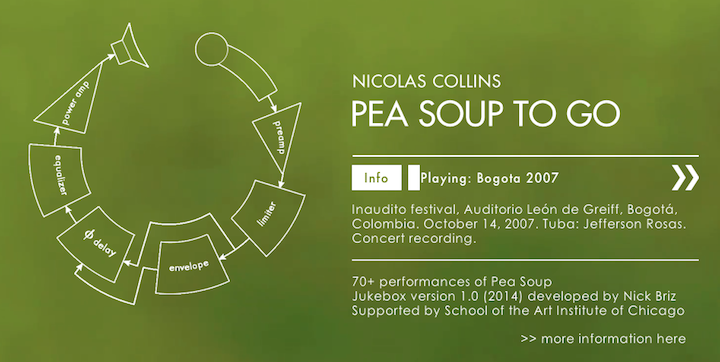
Composer Nic Collins just released his Pea Soup To Go, an open access version of his venerable feedback composition, Pea Soup. Pea Soup To Go is a free streaming audio web application that generates an ever-changing domestic sound art installation on any computer.

Premiered in 1974, Pea Soup creates a self-stabilizing feedback network of microphones and speakers that tunes itself to the architectural acoustics of the space and responds to events—instrumental performances, ambient sounds, human movement, even air currents—with swooping flights of sound. Pea Soup To Go mines decades of performances, including contributions by numerous guest musicians, from around the globe to produce a similarly dreamy soundscape that slowly shifts from key to key as the app shuffles and cross-fades from one recorded space to another.

Pea Soup To Go is being launched on October 24, 2014 — the 40th anniversary of the first performance of Pea Soup.

Point your browser to http://www.nicolascollins.com/peasouptogo/.  Auto-shuffle plays endless variations unattended, or click the arrows to jump to the next track.  Click “Info” for performance details.

cage

Friday, November 21, 2014

Galerie Maio Mazzoli, Berlin, Germany

No tolerance for silence?

Charles Morrow Production and the Faithful! Festival invite you to submit your stereo recordings of John Cage’s flagship composition 4’33” to the David Tudor Memorial 4’33” Competition. Any score edition, instrumentation, or recording location is welcome.

Twelve finalists will featured in MorrowSound installations at Galerie Mario Mazzoli in Berlin and at the Ear Up! Gallery in New York in November 2014. MorrowSound is a state-of-the-art immersive sound environment whose unique approach to vertical movement will transport listeners to the environments in which the performances were recorded.

The Grand Prize winner will receive a one-time cash award of 4,33€ and be announced at the Galerie Mario Mazzoli opening on 16 November.

To submit, please send the following items to fourthirtythree@morrowsound.com

• First and last name
• Postal address, phone number, and email address
• Time, date, and location of the recording
• Name of the recordist, if different from the applicant
• A stereo .wav or .aiff file (preferably 48kHz, 24-bit) OR a download link via wetransfer, soundcloud, or private website
• Please do NOT send mp3s or Dropbox invitations

Deadline for submission: 7 November 2014.

For more information please visit

Charles Morrow Productions
http://www.cmorrow.com/
http://vimeo.com/50825294

John Cage Trust
http://www.johncage.org/about.html

mcm2015-banner-5

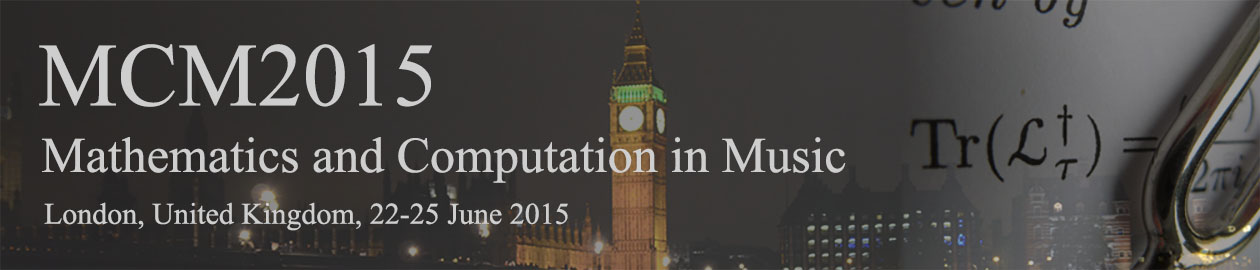
The Fifth Biennial International Conference on Mathematics and Computation in Music(MCM2015) will be held on 22-25 June-2015  at Queen Mary University of London in the United Kingdom. MCM is the flagship conference of the Society for Mathematics and Computation in Music, whose official publication is the Journal of Mathematics and Music.

The aim of the conference is to bring together researchers from around the world who adopt mathematical and/or computational approaches to address any aspect of music theory, music analysis, composition and performance. MCM aims to provide a dedicated platform for the communication and exchange of ideas amongst researchers in mathematics, informatics, music theory, composition, musicology, and related disciplines.

We welcome submissions on any topic relating to mathematics and/or computation and music, including (but not limited to):

  • Mathematical and computational models of and/or approaches to
    • musicology, music theory and analysis, composition
    • musical performance and improvisation
    • the perception and cognition of any aspect of musical structure
    • music and emotion
    • musical learning and education
    • musical interaction and gestures
  • Logical, philosophical and methodological aspects of mathematics and computation in music
  • The history of mathematics and computation in music
  • Applications of mathematical music theory and computational tools for musicians, musicologists and others who work with music

We invite submissions of the following types:

  • Long papers (10-12 pages in the Springer LNCS style) to be presented orally
  • Short papers (4-6 pages in the Springer LNCS style) to be presented as posters
  • Panel discussions
  • Workshops and tutorials

Accepted papers will be published by Springer in an edited volume in the series Lecture Notes in Computer Science, as were the proceedings of previous MCM conferences. For further details on the submissions guidelines for each of these types please checkout the “Submission” site.

The deadline for all types of submission is : Friday 9 January 2015.

Palesdtra NuSon 1

common linnets

The Common Linnets are a musical duo that represented The Netherlands in this years Eurovision Song Contest in Copenhagen. And they came in second. DJ Schmolli created a mix of their song “Calm After the Storm” with the Police’s monster hit “Every Breath You Take”. Listen here to the original and here to the remix.

International Association for the Study of Popular Music, Tilburg University and Erasmus University:
“A long way to the top: The production and reception of music in a globalized world”
6-7 November 2014 – Erasmus University Rotterdam, the Netherlands
Deadline: 1 June, 2014
Keynotes: John Street and Fabian Holt

AIM

Once upon a time, a famous rock ‘n’ roll group sang about what it means to play in a music band. In their lyrics they touch upon the role of the music industry (‘getting sold’), the difficulties of a musical career (‘under-paid’ and ‘getting grey’) and music consumption (‘if you wanna be a star’), while celebrating music for music’s sake. As such, this song addresses many issues in the production and reception of popular music in the contemporary globalized world. Yet, recent developments in the field of music have changed the ‘way to the top’, such as governmental policy on music, the rise of new media, and the growing number of music festivals. Focusing on a select number of interrelated themes, this conference aims to bring together scholars from various countries each with their own perspective to engage in an international exchange of ideas and current research insights about music production and reception.

THEMES

Regarding the production of music, we aim for papers on – but not strictly limited to – these themes:

  • Music industries and scenes: for example, what challenges are music industries facing in the 21st century? How have their business models changed over the last decade? To what extent is music increasingly produced within translocal and virtual scenes outside of traditional music industries?
  • Careers in pop music: for example, to what extent have artist labor markets changed over the last decades? Have music careers become longer and more flexible? What factors determine success?
  • Pop music policy: for example, to what extent and why do government organizations (national and local) fund what types of music? How are pop musicians promoted abroad and for what reasons? What role does music play in urban development and city branding?
  • New media and pop music: for example, how have streaming services changed music industries? Did social media affect the marketing of pop music? How do (online) consumer critics affect sales?

Regarding the reception of music, we aim for papers on – but not strictly limited to – these themes:

  • Pop music consumption and identity construction: for example, how important is pop music in processes of bounding and bridging social groups and group identities? How do music fans use the Internet in processes of meaning-making and sacralization?
  • Music performance, festivals and rituals: for example, how can music performances achieve intended transformative effects? How are they clustered in a particular period of time at a particular place? How can we explain the growing popularity of music festivals among international audiences?
  • Pop music, political activism and social movements: for example, what role does pop music play in social change? How politically engaged are pop musicians and what topics do they address?
  • Popular music heritage and tourism: for example, how and which pop music is being canonized? How does this relate to generational conflict, feelings of nostalgia and authenticity? INSTRUCTIONS

Please send your abstract of 400 words in English (including a research question, theory and methodology) together with a short biography (100 words), including name, institutional affiliation and position, phone number, postal and e-mail addresses, to: iaspmconference@eshcc.eur.nl
Abstract deadline: 1 June, 2014. Participants will receive notifications of acceptance by 1 August, 2014.