
Archives for category: Science

british airways

The airline is pairing its meals with specific tracks, as a study says this can enhance the flavors

British Airways is due to start matching its in-flight meals with specific music tracks in order to counteract the fact that a person’s ability to taste is reduced by 30% while in the air. These pairings are based on a study that suggests some tunes can influence your taste buds, and they aim to help bring out the flavor of the food.

The airline’s new “Sound Bite” menu will be available on the “Rock and Pop” audio channel on long-haul flights from November. This 13-track playlist features music that has been carefully selected to go with each item on the menu, with the intention of enhancing the in-flight meal experience.

A study conducted by Professor Charles Spence and his team at Oxford University in the UK suggests that certain music can influence a person’s taste buds. This has been labelled ‘Sonic Seasoning’, with specific tracks seemingly able to make food seem up to 10% more sweet or salty.

ba-in-flight-meal.jpg

British Airways’ chef Mark Tazzioli adds that the findings of this study to his list of considerations (which also included taste being altered at altitude) in order to create the new special edition menu. The “Sound Bite” playlist includes Scottish artist Paolo Nutini’s “Scream (Funk My Life Up)” to go with the Scottish salmon starter, Coldplay’s “A Sky Full of Stars” for a classic British main meal, Madonna’s “Ray of Light” for desserts, and “Nessun Dorma” by Placido Domingo to go with a cup of coffee.

The reasoning behind these tracks being selected were that Scottish musicians enhance the providence of Scottish foods, British music should be paired with British food, high tones boost the sweet flavors of puddings, and a tenor’s low tones suit the bitterness of coffee. Professor Spence comments:

In the coming months and years we are going to see far more interest in the matching of music and soundscape to what we eat and drink. I think that it is a really exciting and innovative development to see British Airways taking the first steps in this direction.
bogota

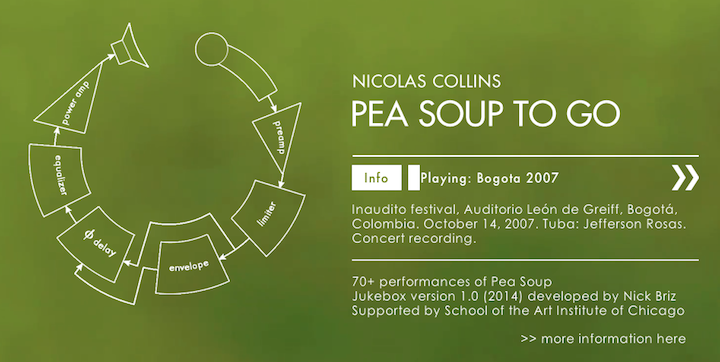
Composer Nic Collins just released his Pea Soup To Go, an open access version of his venerable feedback composition, Pea Soup. Pea Soup To Go is a free streaming audio web application that generates an ever-changing domestic sound art installation on any computer.

Premiered in 1974, Pea Soup creates a self-stabilizing feedback network of microphones and speakers that tunes itself to the architectural acoustics of the space and responds to events—instrumental performances, ambient sounds, human movement, even air currents—with swooping flights of sound. Pea Soup To Go mines decades of performances, including contributions by numerous guest musicians, from around the globe to produce a similarly dreamy soundscape that slowly shifts from key to key as the app shuffles and cross-fades from one recorded space to another.

Pea Soup To Go is being launched on October 24, 2014 — the 40th anniversary of the first performance of Pea Soup.

Point your browser to http://www.nicolascollins.com/peasouptogo/.  Auto-shuffle plays endless variations unattended, or click the arrows to jump to the next track.  Click “Info” for performance details.

image010

Topic

Up to this moment, there is no satisfying business model for Open Access journals within the Humanities. Yet, there is no turning back especially now the call for Open Access is strongly supported by politicians and funders.
Is it possible to keep existing journals afloat in an Open Access world? Or do we need to make more radical choices by reforming publication culture and journal formats in the Humanities?

This symposium, organised by TS·> Tijdschrift voor tijdschrift­studies and Utrecht University Library, will explore possible solutions for scholarly journals that are contemplating or planning a transition to Open Access, and for journals that are currently trying to survive in Open Access. Experts from the international field of Open Access publishing for Humanities will share their views and experiences.
Furthermore, several journal editors who made the transition to OA will talk about their new business models and the challenges they are facing.

Confirmed speakers and programme

  • Anne Bindslev, PhD (Co-Action Publishing, Senior Publisher)
  • Jan Erik Frantsvåg, MA (University of Tromsø, Open Access Adviser
  • Inge Werner, PhD (Utrecht University Library, Publishing Consultant)
  • Leonie de Goei & Aad Blok (PhD, Royal Netherlands Historical Society, PublisherBMGN – Low Countries Historical Review, & Managing Editor BMGN – Low Countries Historical Review, resp.)
  • Marcel Cobussen, PhD (Leiden University, Founding Editor Journal of Sonic Studies)
  • Esther Op de Beek, PhD (Leiden University, TreasurerTS·> Tijdschrift voor Tijdschriftstudies)

Date and location

  • 17th of October 2014
  • Utrecht University Library, Heidelberglaan 3, 3584 CS Utrecht,
    The Netherlands

Registration

The origin of human music has long been the subject of intense discussion between philosophers, cultural scientists and naturalists. Researchers from the Max Planck Institute for Ornithology in Seewiesen, Germany and Cornish College of the Arts in Seattle, US, have now found striking parallels between our music and the song of a small brown bird living in the Amazon region. The Musician Wren favors consonant over dissonant intervals, something that has rarely been observed in other animal species before. This bird’s musicality goes even further: it prefers to sing perfect consonances (octaves, perfect fifths, and perfect fourths) over imperfect consonances leading to some passages which may sound to human listeners as if they are structured around a tonal center.
More info on http://www.mpg.de/7572084/bird-song-human-music

According to the German studio Finally one cannot understand music. One can be seduced by music, or simply enjoy it. But to understand it – that’s impossible. See their animation below.

The main idea reminds me of an interview Pierre Boulez once had on a French television station with a writer whose name I’ve forgotten. First music is a mystery, the writer told Boulez. Then, after studying it, everything becomes clear. But, finally, with the performance, it becomes a mystery again.

The central question, however, remains: can some knowledge about music enhance the enjoyment or is knowledge sometimes obstructing certain encounters with music? Or do both statements contain some kind of truth?

On December 7, 2012 I’m organizing a small, 1-day conference on auditory culture in The Netherlands. 20-25 people dealing with sound will gather in a venue in Leiden to discuss sound: philosophers, sound artists, biologists, architects, audiologists, sound designers, psychologists, people from governmental organizations dealing with noise abatement, etc. Aim is to exchange thoughts, to transgress discourses, and to develop a common research strategy. 

Finish researchers from the Aalto University in Helsinki recently recorded the sound of aurora borealis. Point of departure is that light produces sounds. Up until now, the sounds of Northern Lights have always been described as hissing, sighing, or crackling. However, here we can hear ‘clap sounds’, like the snapping of a whip.